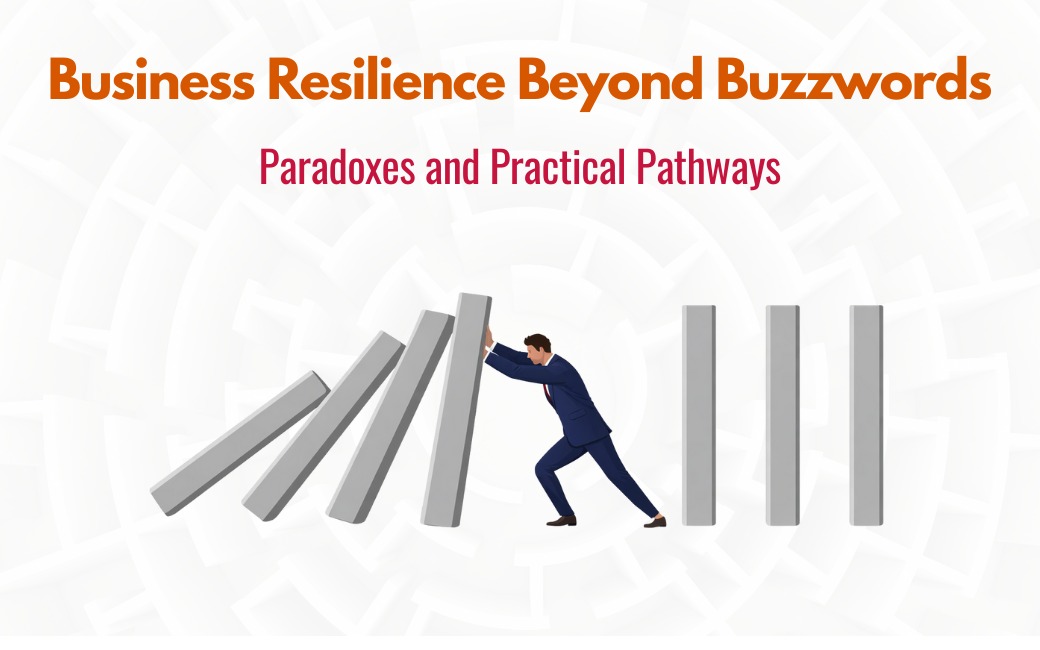

Geopolitical risk is no longer experienced as isolated disruption. It increasingly shows up as persistent friction that reshapes how businesses operate. Rather than stopping activity, it alters cost, speed, reliability, and decision making.
This shift changes the nature of resilience. Organizations are no longer preparing only for recovery. They are learning how to operate within constraint.
Business Continuity Management buys time. Strategy restores freedom. The value lies in how effectively one is converted into the other.
From Shock to Operating Condition
Traditional risk frameworks are built around events. A disruption occurs, operations are impacted, and recovery follows. Geo friction does not behave this way.
It introduces partial, ongoing constraints that rarely shut operations down completely, but steadily erode efficiency and control. In practice, this may appear as:
- Payment channels that remain available but become slower or risk exposed
- Supply chains that continue but lose predictability
- Compliance requirements that become more complex and interpretive
- Data flows that remain technically possible but legally uncertain
- Insurance coverage that exists but becomes limited through exclusions
The challenge is no longer simply recovery. It is maintaining control while the external environment continues to shift.
The Role of BCMS: Operating Within Constraint
BCMS remains essential, but its role evolves in a friction driven environment. It is no longer only about restoring operations. It is about maintaining controlled performance under restriction.
A mature BCMS capability focuses on stabilizing outcomes rather than preserving processes. This includes:
- Delivering minimum viable service levels with explicit trade offs
- Mapping dependencies beyond operations, including regulatory and permission constraints
- Defining decision rights in environments where clarity is limited
- Protecting operational integrity before resuming activity
- Planning for backlog clearance and reconciliation once constraints ease
At its best, BCMS converts uncertainty into governed operational behavior. It keeps the organization functional when conditions deteriorate.
Where BCMS Reaches Its Limit
The limitation of BCMS emerges when temporary measures become embedded into daily operations.
Over time, organizations may find themselves relying on repeated workarounds, informal substitutions, and case by case decisions. Operations continue, but with increasing friction, cost, and inconsistency.
This creates the illusion of resilience. In reality, it signals strategic drift.
The business is no longer recovering. It is adapting informally without redesigning for the environment it now operates in.
Where Strategy Takes Over
Strategy becomes critical when friction is no longer episodic but structural.
The focus shifts from managing disruption to redesigning the organization so that the same constraints do not repeatedly create operational damage. In this context, the most valuable strategic capability is optionality.
Optionality is the ability to choose between suppliers, routes, jurisdictions, and operating models without triggering disruption.
This requires deliberate design decisions, such as:
- Diversifying supplier and partner ecosystems
- Structuring operations across multiple jurisdictions
- Building alternative payment and transaction pathways
- Redefining customer commitments to reflect operating realities
- Designing flexible data and platform architectures
These are not continuity responses. They are structural changes that determine long term resilience.
The Critical Overlap: Converting Time into Freedom
The strongest organizations do not treat BCMS and strategy as separate disciplines. They design the connection between them.
BCMS stabilizes the present. Strategy reshapes the future. The overlap is where operational stress becomes strategic insight.
Without this connection, organizations repeat the same disruptions without learning from them. With it, they convert temporary survival into long term advantage.
When Continuity Is No Longer Enough
A key challenge is knowing when to move from managing disruption to redesigning the operating model.
This shift should not be subjective. It should be triggered by clear signals, such as:
- Repeated occurrence of the same constraint
- Increasing cost of operational workarounds
- Ongoing pressure on customer commitments
- Persistent regulatory or compliance bottlenecks
- Reduced ability to maintain operational integrity
- Delays in decision making due to uncertainty
These triggers prevent temporary solutions from becoming permanent inefficiencies.
MCA Gulf Perspective
In a geo friction environment, the risk is not always disruption. It is gradual loss of control, visibility, and consistency.
MCA Gulf supports organizations in strengthening resilience by connecting business continuity with strategic design. This includes assessing geopolitical exposure, enhancing BCMS frameworks, and advising on structural changes that improve flexibility, governance, and long term performance.
The objective is not only to remain operational, but to remain governable.
For advisory support on resilience, risk, and strategic design, reach out to mcagrc@mcagulf.com.