
Beyond Recovery: Building Organizations That Bounce Forward
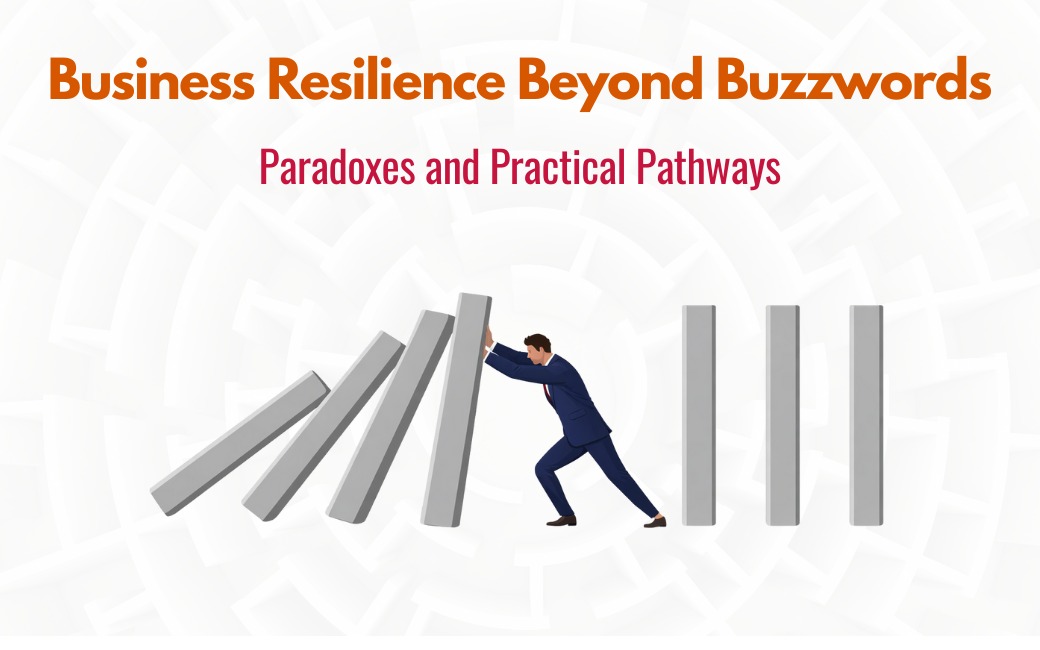
Resilience has long been the corporate world’s insurance policy, a promise that if things went wrong, the business could “bounce back.” But in today’s environment, resilience can no longer be about bouncing back. It must be about bouncing forward.
That is because disruptions today do not occur as isolated shocks. They arrive layered, interconnected, and accelerating. A cyberattack does not just impact IT; it can halt supply chains, trigger regulatory scrutiny, and erode customer trust in a single sweep.
The Paradox of Modern Resilience
Here lies the paradox. Organizations invest more in risk management than ever before, yet feel less resilient. Why? Because traditional approaches are often static, compliance oriented, and designed for yesterday’s risks.
Resilience cannot be a manual on the shelf waiting for the next crisis. It has to be a living capability embedded into decision making, culture, and the very design of the business model.
Key Paradoxes to Navigate
- Efficiency versus Redundancy
Efficiency trims fat; redundancy may look like waste, until it saves the business. Think of holding spare inventory, a backup supplier, or extra server capacity. Resilience often hides in what appears inefficient on paper. - Centralization versus Decentralization
Centralized leadership provides clarity and speed, while decentralized teams enable flexible, local decision making. In a crisis, both are essential; strong guidance from the center combined with autonomy at the front line to respond effectively. - Forecasting versus Flexibility
Forecasting provides a sense of direction, but disruptions seldom unfold as planned. Resilient organizations pair forecasts with a culture of humility, remaining ready to adjust decisions when reality takes an unexpected turn.” - Standardization versus Innovation
Standardization reduces errors and ensures consistency. Yet, in times of upheaval, innovation requires looser structures and experimentation. Knowing when to tighten and when to loosen is critical.
Great leaders do not “solve” these paradoxes; they learn to live in them, adjusting the balance as circumstances evolve.
Practical Levers: Embedding Resilience in the Business Model
Resilience must now be embedded in the core design of the business model, not just in continuity playbooks. Here are five practical levers for operationalizing resilience:
- Build Resilience into the Core Business Model
Do not treat resilience as an afterthought. Stress test the business model itself. Diversify critical suppliers and distribution channels to prevent a single point of failure.
Illustrative Case:
A European automotive manufacturer faced major semiconductor shortages. Instead of waiting for supply to normalize, it redesigned its supplier ecosystem, implemented dual sourcing for critical components, invested in regional warehousing, and developed a real-time supplier monitoring dashboard. When subsequent disruptions occurred, the company continued production while competitors struggled, gaining both market share and strategic credibility.
- Make Resilience Measurable
Move beyond vague assurances. Introduce metrics such as time to recover, cost absorbed per disruption, and the percentage of critical functions with tested continuity plans. Resilience should be as visible on dashboards as revenue and margins.
Illustrative Case:
A healthcare provider was hit by a ransomware attack that encrypted patient scheduling and billing systems. Instead of offering blanket assurances, leadership measured resilience with clear metrics.
-
-
- Recovery Time: Well below the RTO objective.
- Cost Absorbed: USD 480K (tiny fraction of OPEX, within tolerance)
- Continuity Coverage: 95% of critical functions tested & operational
- Service Impact: Zero disruption to emergency care & pharmacy; minor delays in non-urgent billing
-
Illustrative Case:
A large logistics firm experienced sudden surges in e-commerce demand during a regional lockdown. Cross-trained employees were redeployed across warehouse operations, customer service, and last-mile delivery. This flexibility reduced delays, minimized customer complaints, and demonstrated that human adaptability is as critical as technological infrastructure.
- Rethink Technology as a Resilience Enabler
Technology should not be only about efficiency. Cloud infrastructure, scenario simulation tools, and advanced monitoring systems can provide foresight and speed in recovery. True resilience is demonstrated by how technology enables rapid adaptation under pressure. - Rehearse the Unimaginable
Many crisis playbooks cover obvious risks. Real resilience comes from testing unlikely but high-impact events: concurrent crises, reputational attacks during operational outages, or loss of critical partners. Tabletop exercises and war games should stretch the organization’s imagination beyond compliance.
The Mindset Shift
Resilience is no longer just a defensive shield. It is a source of competitive advantage. Organizations that can absorb shocks and bounce forward attract investors, retain customers, and win in markets where fragility is now the norm.
Final Word
Resilience is not only about avoiding disruption; it is about building continuity into the core of the business. The strongest organizations treat it as a strategic capability, integrating paradox management, measurable levers, cultural agility, and practical preparedness into every aspect of their operations.
How ready is your organization for disruption?
MCA’s Resilience Readiness Assessment (RRA) helps you understand how well your business can anticipate, withstand, and recover from unforeseen challenges.
This structured diagnostic evaluates resilience across governance, operations, technology, and people, delivering a clear Resilience Maturity Score and actionable roadmap to strengthen organizational readiness.
Turn Uncertainty into Preparedness
Build lasting resilience with MCA’s Resilience Readiness Assessment. Connect with us at mcagrc@mcagulf.com